



April 30, 2026 – In the past, private equity (PE) investing was limited to institutional investors and ultra‑high‑net‑worth individuals. Recently, that has changed. Regulatory shifts and innovative offerings have expanded access to private equity, making it an option for more investors to diversify into this asset class.
Additionally, these changes have increased the number of PE options from which to choose. This article discusses the expanding range of private equity options and investment strategies now available to individual investors and how to compare them.
The historical limitations of private equity—and how they have changed
Private equity entails owning a portion of one or more private companies. PE funds raise monetary capital to purchase portfolio companies (in whole or in part) and utilize their intellectual capital to increase the value of the business for a future sale, where a portion of the gains would be distributed to investors.
While past performance is not indicative of future results, over certain periods, private equity has outperformed some other asset classes and exhibited lower correlations to public markets, which is one reason many institutions have used PE for diversification.
However, traditional private equity structures include some constraints that have made it inaccessible to individual investors. These include:
- High minimum investments and capital calls: Often up to $1 million, investors pledge a certain amount up front and are required to meet periodic capital calls over the life of the fund, which necessitates maintaining liquid reserves.
- Illiquidity: Traditional PE funds typically have multiyear holding periods—often seven to 10 years or more—with no opportunity for early redemption.
- Use of leverage: Many private equity strategies, particularly leveraged buyouts, employ significant borrowing as part of their investment approach, which can amplify both gains and losses.
- J‑curve effects: Early returns may be low or negative as capital is deployed and fees accrue before portfolio companies begin generating value, a dynamic discussed in our blog post on the J‑curve.
More recently, non‑traded alternative investment sponsors have introduced private equity offerings designed to make the asset class more accessible to individual investors. These new structures retain many characteristics of private equity but incorporate features intended to ease some of the traditional barriers. Common features include:
- Lower investment minimums: sometimes starting at around $5,000.
- No capital calls: as investors typically fund their full commitment upfront.
- Liquidity options: such as the ability to redeem a portion of holdings on a monthly or quarterly basis, subject to program limits.
- Regular valuations: often monthly, to help investors track the value of their holdings.
- Enhanced transparency: including more frequent reporting and clearer insight into portfolio composition and performance.
It is important to note that offering details vary by product, and non‑traded investments have restrictions that limit an investor’s ability to liquidate.
Comparing the Options
With the increased availability of investment options for individual investors, differentiating between the offerings can be tricky as not all private equity funds are identical. The framework below can help compare the variety of private equity offerings available.
1. Stage of portfolio companies in the business cycle
Funds invest in portfolio companies at different stages of their life cycle, and each phase requires different capabilities from the manager. It’s important to understand which types of portfolio companies a fund is targeting, and why—along with the specific capabilities the fund has to support companies in their life cycle. For example:
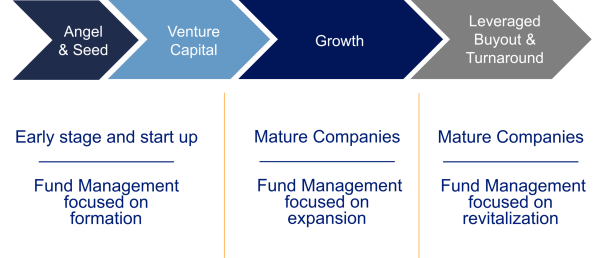
Angel and seed stages refer to the initial phases in which some companies raise funding. These early stages typically involve very young businesses, often with limited operating history and higher risk. While these opportunities are generally outside the scope of most private equity offerings available to individual investors, they help provide context for where venture capital fits within the business life cycle.
Venture capital (VC) typically focuses on early‑stage companies, or startups, with high growth potential. Companies at this stage may have shown initial promise but are less established and often seek substantial capital for the first time. PE funds look to offer these businesses crucial guidance needed at this formative stage. Portfolios may be concentrated in a single industry, such as technology, aligning with the manager’s expertise in the area. Investors at this stage seek high growth while accepting elevated risk, as a significant number of early‑stage companies fail.
Growth equity PE funds typically concentrate on successful, well-established businesses that either lack the expertise or desire to grow the company further. PE managers that focus on this stage of a company typically look to use their expertise to help expand the business. They can do this by enhancing production capabilities, engaging in new markets or pursuing add‑on acquisitions accretive to the overall business value. Investors at this stage are seeking growth with the potential risk mitigation of established businesses in the portfolio.
Leveraged buyout (LBOs) and turnaround strategies typically involve acquiring more mature businesses, often using significant leverage. These companies can be either struggling or successful, but all have been identified by PE managers as having opportunity for improvements that could translate to an increase in value. These funds use their expertise to make swift changes to the efficiency and profitability of the company. Investors at this stage of PE seek access to the potential elevated returns and are willing to accept the risk that accompanies increased leverage.
Companies move through distinct phases in their life cycle, and each phase aligns with different private equity strategies. The visual below shows how these strategies map to the business cycle and the types of company needs associated with each stage.
2. Sector focus and portfolio strategy
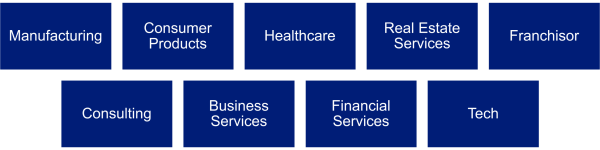
Many PE funds focus on a particular industry or niche, such as healthcare, consumer goods, manufacturing or financial services. Funds that take this approach often seek to generate synergies and economies of scale across the portfolio, along with the sharing of ideas and best practices.
This approach requires in-depth industry expertise. Understanding the resources the team has to support companies in the target sector(s) and the risks and opportunities within that sector(s) is essential.
Another consideration is the portfolio strategy—the mix of asset types and investment approaches the fund employs. While many private equity funds focus solely on equity ownership in private companies, others take a broader approach that may include private credit, real assets or other alternative strategies.
Beyond determining the asset mix, portfolio strategies regularly include thematic or strategy‑driven elements. For example, a portfolio may be organized around themes like digital transformation, sustainability or demographic shifts to capitalize on long‑term trends.
Geographic focus can also play a major role: some funds prioritize North America or the U.S. middle market, while others intentionally target global opportunities across both developed and emerging markets.
Understanding a fund’s portfolio strategy helps assess how the manager intends to create value, manage risk and deliver returns, particularly because different strategies may behave differently across market cycles.
3. Structure of the offering
Private equity funds are structured in different ways, and those structures shape how investors gain exposure to the asset class. For individual investors, two common approaches are direct private equity and fund of funds structures.
Direct private equity
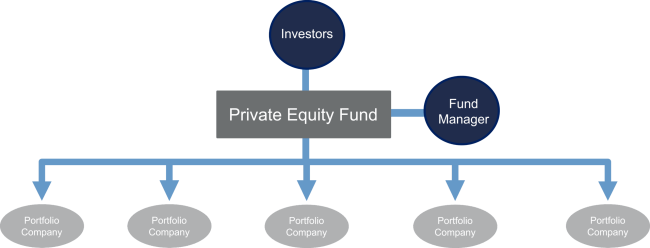
In this model, investors buy shares of a fund that owns stakes in a group of private companies. The fund manager raises capital, selects portfolio companies and oversees strategic and operational decisions intended to help those companies grow over time. This structure provides direct exposure to private companies under the expertise of one manager.
How a direct private equity fund is structured: Structure of a direct private equity fund, showing how investor capital flows to a single manager overseeing a portfolio of companies.
Fund of funds
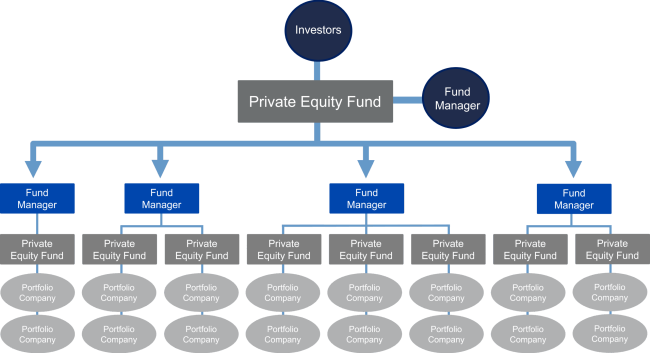
A fund of funds invests in a portfolio of other private equity funds rather than directly in operating companies. The fund manager raises capital and selects investments in existing private equity funds that align with the stated investment thesis. This structure provides exposure to multiple managers and strategies within a single investment.
How a fund of funds allocates capital across multiple private equity managers: Expanded view of a fund of funds structure, with investor capital flowing into a primary fund that invests across several underlying managers and their portfolio companies.
4. Valuations
Historically, traditional PE funds provided limited information about the value of portfolio companies, but that is changing. Today, as the PE industry evolves, funds available to retail investors are more likely to provide monthly or quarterly valuations to their investors.
Some funds also work with third‑party specialists to validate objective data about a portfolio company’s value. When comparing private equity options, it is important to understand a firm’s valuation methodology and whether a third‑party valuation firm is used.
Private equity may be an option for some clients, but they should understand the full set of considerations before deciding to invest. Financial professionals can help clients compare the types of PE offerings, assess tradeoffs relative to other investment categories, and select the approach that aligns with their needs.
For a quick reference on comparing private equity options for your clients, download our private equity comparison guide.
Represents CNL’s view of the current market environment as of the date appearing in this material only. There can be no assurance that any CNL investment will achieve its objectives or avoid substantial losses. Diversification does not guarantee a profit nor protect against losses.
CSC-0426-5084591-INV