

July 29, 2021 – Traditional private equity investments are not open to individual investors. Private equity has generated higher returns than some other asset classes over the past 10 years, but it also has higher costs and risks.1 Primarily because of this, participation is often limited to investors with $5 million or more in assets. Another challenge is that private equity investments require significant capital up front and take time before they are expected to generate any returns, a phenomenon called the “J-curve effect.” A differentiated form of private equity where the debt and equity investment come from one provider alongside the existing management team, could potentially generate some of the benefits of traditional private equity in a way that’s more accessible to individual investors, and it may limit some of these negative aspects.
Understanding the J-Curve Effect
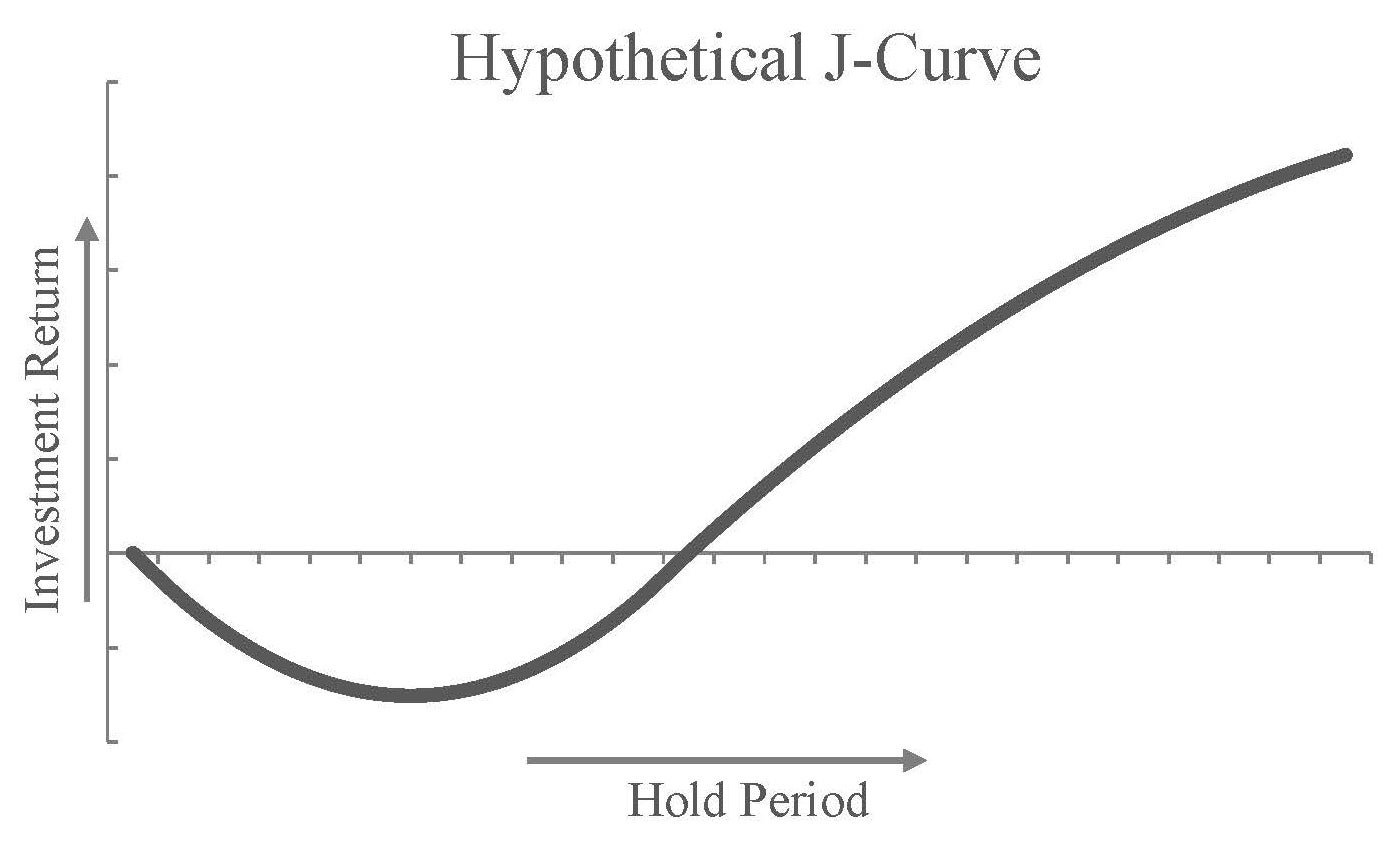
It sounds like the name of a spy thriller, but the J-curve effect is a phenomenon that happens during the early years of an investment in traditional private equity. During the investment period, fees are charged and returns can be slow to come in, because of the way these investments are structured. When a private equity fund launches, investors commit a certain amount of money, which gets drawn down as investment opportunities are identified. That process may take up to three to five years, but investors typically pay management fees on the full amount of capital they committed, starting on day one.
For example, if an investor commits $100,000 to a fund that charges a 2% annual management fee, the investor will pay that fee on the full $100,000 in the first year. That’s true even if the fund only invests a portion of the amount in the first year. To further illustrate this hypothetical example, let’s assume that only $20,000 is invested in the first year, the investor would pay $2,000, effectively resulting in a 10% management fee on invested capital that first year.2
Another factor is that if a private equity fund invests in distressed businesses — the kind that require a turnaround — it would generally lead to even higher upfront costs. And in some cases, funds boost their initial investments in businesses by borrowing money from third parties. If the investments begin to pay off, that senior debt typically gets paid off first, before equity investors begin to see returns.3
These factors can lead to a net outflow of cash during the early years of a typical private equity investment. When returns are plotted on a graph (see exhibit), it looks like the letter “J.” (Some in the industry refer to this as the “valley of tears.”)4
Due to the speculative nature of private equity, some investments may never generate a positive return.
Three Ways to Smooth the Curve
However, there are three ways to smooth out the J-curve, potentially reducing and/or shortening this period for investors:
- Invest in a company that charges fees on invested capital, rather than committed capital.
- Invest in a company that seeks to acquire durable and growing businesses, rather than those in distress.
- Invest through a combination of private equity and debt with the goal of generating both income and growth.
The first such strategy is to invest in a company that is established and charges fees when capital is invested. In this way, an investor’s capital is not charged management fees until it is put to work.
The second strategy for smoothing the J-curve is to avoid acquiring businesses that need turnarounds. These can be strong performers over the long haul, but they carry higher risk and often need repeated infusions of working capital early on, meaning a longer period of negative cash flow for investors before the investment may generate a return. Instead, invest in a company that focuses primarily on strong, healthy businesses that need capital in order to grow (rather than recover).
Third, invest in a strategy that often owns both the controlling equity positions alongside debt positions, rather than equity alone. The addition of private debt is appealing as the interest payments may generate income. When distributed, that income can further flatten the J-curve.
To be clear, private equity is a complex investment strategy, and it is not right for everyone. It requires that suitability standards be met, and it requires a long-term time horizon and a greater tolerance for risks and fees compared to traditional investments. That said, a differentiated private equity investment may help investors access some of the upside using a traditional private equity strategy while potentially reducing some of the drawbacks, including the J-curve.
1 Past performance of an asset class is no indication for future results.
2 This illustration does not take into account any sales loads, upfront fees or fund level fees and expenses that the investor would bear.
3 “Understanding How the J Curve Works in PE and Economics,” Corporate Finance Institute, Dec. 7, 2019.
4 Jason D. Rowley, “Inside the Ups and Downs of the VC J-Curve,” Crunchbase News, Sept. 20, 2019.
Represents CNL’s view of the current market environment as of the date appearing in this material only. There can be no assurance that any CNL investment will achieve its objectives or avoid substantial losses.
CSC-0826-5782895-INV