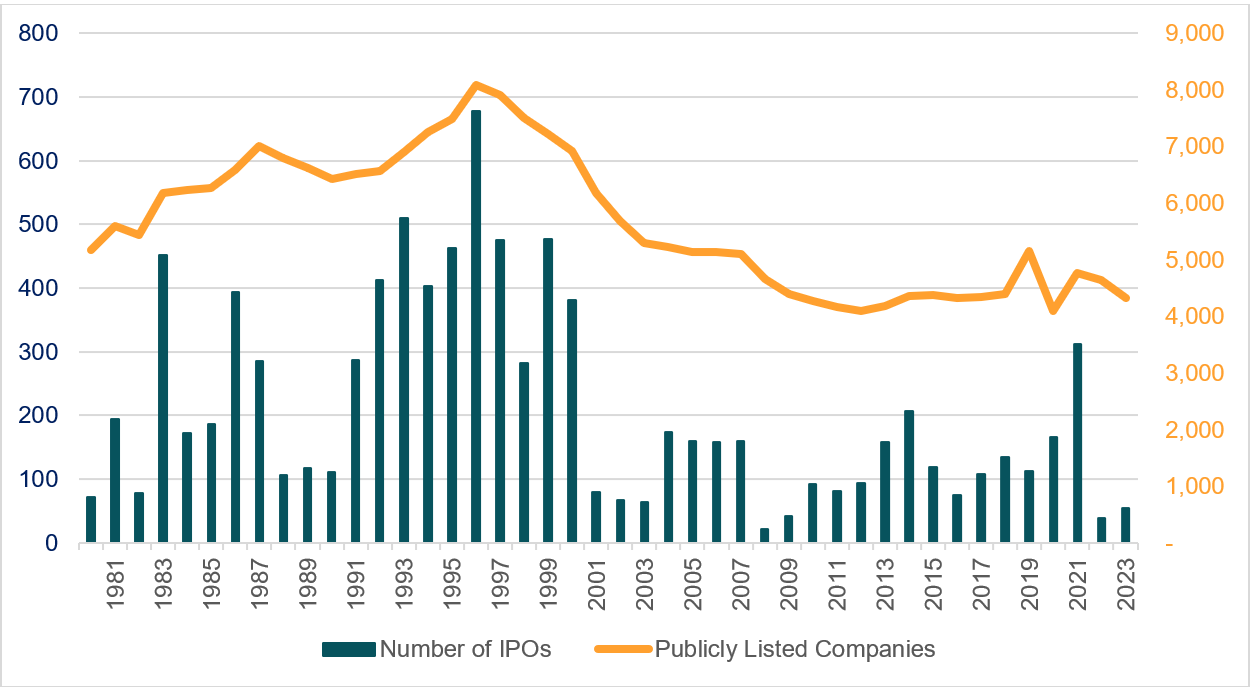

In 1996, the number of public companies peaked at more than 8,000. Today, there are approximately 47% less.
SOURCES: “Listed Domestic Companies, Total,” World Federation of Exchanges, 2023. Jay Ritter, “Initial Public Offerings: Updated Statistics,” University of Florida, 2023.
That combination is creating a financing gap, which private equity firms are filling. These firms do not provide capital alone — they also offer strategic and technical expertise to help make fast-growing firms more successful. Rather than extracting value from these businesses, they partner with a goal to create value, using several potential tools.Ways to Create Value – Organic and Inorganic Growth
One potential means of value creation is organic growth. Organic growth is growth that is achieved through internal resources and capabilities. Private equity partners can bring a fresh look to a company’s business units and portfolio of products and services and ask whether there are ways to increase revenue by expanding or improving existing product lines, moving into new geographic markets or sales channels, or developing new products and services.
Pricing is another means of organic growth. Many organizations do not look strategically at the prices they charge, instead relying on “what we charged last year.” A common tool that private equity firms will apply is optimizing pricing, by determining how to increase prices without affecting demand.
Operational improvements to portfolio companies are another example of organic growth. Because these firms tend to have wide-ranging experience in an industry, they can bring best practices to the companies they acquire. This is particularly relevant in terms of integrating technology into the business, streamlining operations to reduce waste or implementation of lean manufacturing.
A second means of possible value creation is inorganic growth through merger and acquisition (M&A) deals. Firms can create value by making strategic acquisitions — typically of smaller, complementary businesses that they can tuck into the parent company — and generate some cost savings or synergies between both businesses. Smaller deals often have lower multiples, and firms can bundle together several companies in a similar industry to generate scale advantages. Inorganic growth may also give organizations rapid access to fast-growing products, markets, or customer bases — often significantly faster than a company could achieve through organic growth.
Partnering with Management
Another key aspect of this differentiated private equity strategy is that it aligns the interests of key stakeholders. Firms typically take a majority stake but retain the existing management team, often with attractive incentive plans that give that team “skin in the game.” In other words, the existing management teams of the acquired businesses may have meaningful ownership alongside the investment managers. For that reason, the company’s minority owners retain the motivation to roll up their sleeves and continue to grow the business.
Potential Benefits for Investors
As stated earlier, this differentiated form of private equity differs from traditional private equity because it typically combines equity ownership alongside a debt investment in the same private business. The combined potential for both income and capital appreciation can create a total-return investment. The debt securities can provide income from interest payments on the debt investment. (Traditional private equity includes no debt investment, so investors don’t see any returns from those holdings until the portfolio companies are sold and the fund is liquidated.) Growth can come through the equity ownership if the business value increases. Ideally, the company will be worth more over time due to improvements to the business, which may generate higher returns for investors.
Because the strategy is the acquisition of private companies, it may offer investors diversification in assets that do not move in tandem with the publicly traded markets. Last, this distinct strategy gives individual investors access to private companies that had previously been limited to institutional investors.
Private equity has limited liquidity, is not suitable for all investors, and entails higher risk than traditional investments. As a result, you will need to work with clients to determine whether it is a fit for their portfolio and long-term financial goals. But for those who want to invest to help grow durable companies, this differentiated form of private equity may offer diversification.
1 “Listed Domestic Companies, Total,” World Federation of Exchanges, 2023.
2 Vasco Curdia, “Economic Effects of Tighter Lending by Banks,” Federal Reserve Bank of San Francisco, May 24, 2024.
Represents CNL’s view of the current market environment as of the date appearing in this material only. There can be no assurance that any CNL investment will achieve its objectives or avoid substantial losses. Diversification does not guarantee a profit nor protect against losses.
CSC-1224-3552135-INV