



Feb. 26, 2026 – A potential business sale brings a new layer of complexity to the exit planning process. For many owners, evaluating exit paths, assembling the right team and confronting the hesitation that often arises can feel unfamiliar and overwhelming. As a financial professional, your role is to help clarify next steps, coordinate the right expertise and guide business owner clients toward informed, confident decisions.
In part one of our exit planning series, we highlighted that the biggest way you can support business owner clients is by asking the right questions — the kind that spark productive conversation, uncover concerns and help clients build momentum. Whether an owner is beginning to consider a sale or is responding to unexpected circumstances, these questions can set the stage for a smoother process and a more successful outcome.
In this second installment, we focus on three essential elements of exit planning strategies: exploring exit options, building the right team and overcoming hesitation. These pillars help financial professionals navigate the complexities of a potential sale and prepare owners for what comes next.
1. Exploring Exit Options
Question for the business owner: Do you know which exit paths best support your goals?
Business owners often don’t realize that an exit doesn’t have to mean walking away entirely. Many retain an equity stake and some degree of control. Owners can sell the entire company, a majority or minority stake, or a smaller portion of equity sufficient to recapitalize outstanding debt. As the exit vision becomes clearer, owners should determine how much equity to sell based on how involved they want to remain and how much control they want to retain. Selling a larger stake in the business generally provides greater liquidity, while selling a smaller stake allows owners to preserve more day‑to‑day control.
In addition, business owners should be prepared for private‑market buyers to rely on one of three standards of value when determining what their business is worth:
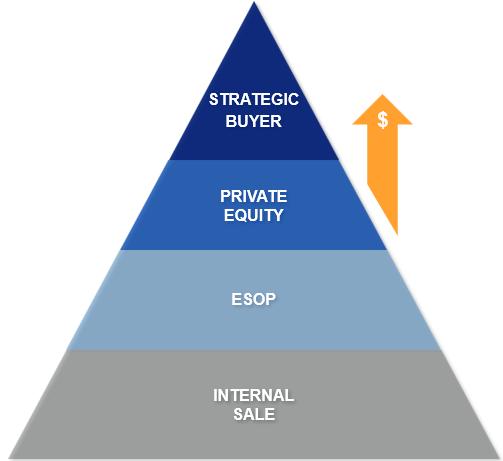
How Buyer Types Align With Value
Investment Value:
Private equity firms or third-party buyers in the same or related industries may be willing to pay more because they base the price on the investment value specific to them. For these buyers, the business may offer strategic advantages in how it complements their existing assets — potentially justifying a premium.
Fair Market Value:
Fair market value is often used by buyers such as an employee stock ownership plan (ESOP) or family succession buyers. This valuation method reflects market conditions, including supply and demand, which can influence whether a business is viewed as more or less valuable.
Fair Value:
Fair value is a valuation method determined by statute, reflecting the value of the underlying assets of the business not linked to market conditions. It reflects the valuation litigators or auditors would put on the business.1
These options carry different trade‑offs for owners, including liquidity versus control, speed versus certainty and price versus after‑tax proceeds. Clarifying those dynamics early helps guide a more confident, well‑sequenced exit.
2. Building the Right Team
Question for the business owner: Do you have the right professionals guiding your exit?
Leveraging a team may create short‑term costs, but their expertise can have significant long‑term benefits — helping increase valuations, reduce tax exposure and structure strategies that preserve legacy wealth. Business owners should work with a team of specialists to cover all their bases and ensure that they can engage with experienced, sophisticated buyers.
The team may include:
- Board of Advisors
- Financial Advisor
- Risk Advisor
- Attorney
- Estate Planner
- CPA
- M&A Advisor
- Investment Banker
- Growth Consultant
- Family & Family Business Advisor
These subject matter specialists bring invaluable insights into understanding current market conditions and assessing a potential transaction through the lens of their expertise.
Some of these professionals may already be in place as part of the business owner’s advisory team, but it’s critical to build a team with sufficient — and recent — experience in business exits. As part of the due diligence in evaluating team members, business owners should ask how many business exits a particular specialist has successfully supported. At this point, any conflicts of interest, such as a referral arrangement with a CPA, should be disclosed.
3. Overcoming Hesitation
Question for business owner: What’s stopping you from taking the next step?
Perhaps the most important way in which you can help business owners is by emphasizing the need to start the exit planning process early. Many owners think they don’t need to worry about exit planning until they’re officially ready to sell. However, an unexpected event like an illness, divorce or economic downturn may force them into selling. In fact, the Exit Planning Institute (EPI) has reported that 50% of exits are involuntary and 75% of owners regret selling within 12 months of an exit.2
The planning process takes time, and starting early can help ensure that business owners are considering all options from a position of strength, rather than being pushed into a hasty transaction.
Signs that it may be time for a business owner client to consider exit planning include:
- Receiving unsolicited offers
- Considering retirement or succession
- Wanting to step back from daily operations
- Being curious about the current valuation
- Seeking to reduce risk and protect their family’s interests
- Having a large portion of their wealth concentrated in the business
Owners may think that conversations about exit planning are premature, but starting early and taking a few small steps may help the owner reduce financial exposure, preserve their options and ultimately move forward with a transaction that fits their goals and priorities.